
New FY 2026 STOP School Violence Grant Offers More Than $111 Million for School Safety Initiatives
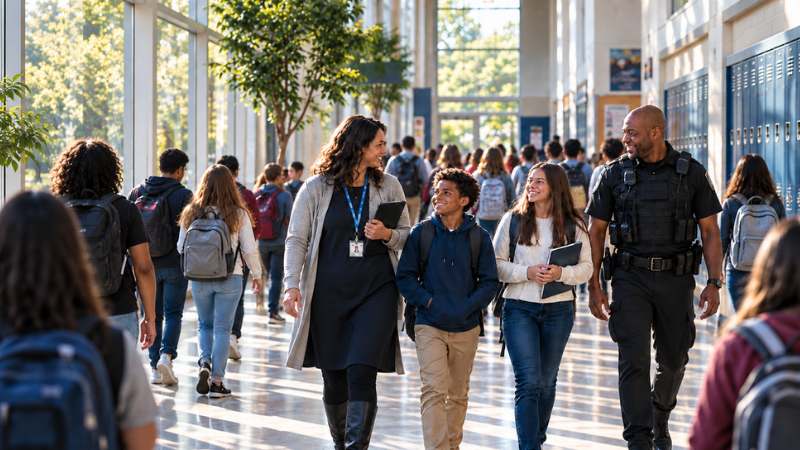
Schools and communities looking to strengthen violence prevention efforts have a new federal funding opportunity available.
The U.S. Department of Justice’s Bureau of Justice Assistance (BJA) has released the FY 2026 Students, Teachers, and Officers Preventing (STOP) School Violence Program, with up to $111.1 million in expected funding available for projects designed to prevent and reduce school violence. The program specifically supports initiatives such as training, threat assessment and intervention teams, anonymous reporting technology, and other eligible school safety solutions.
For schools, districts, local governments, and other eligible organizations considering new safety technology, this grant creates an opportunity to invest in solutions that help identify potential threats earlier and improve coordination when concerns are reported.
FY 2026 STOP School Violence Grant at a Glance
The FY 2026 funding opportunity was released on September 21, 2026. BJA anticipates making approximately 95 awards across two applicant categories, with projects expected to run for 36 months beginning January 1, 2027.
Key details include:
- Total expected funding: Up to $111,145,913
- Category 1: States and public or state-controlled institutions of higher education — awards of up to $2 million
- Category 2: Local governments, federally recognized Tribal governments, nonprofits, school districts and other eligible entities — awards of up to $1 million
- Cost share: No matching funds are required
- Grants.gov deadline: October 30, 2026, at 11:59 p.m. ET
- JustGrants deadline: November 6, 2026, at 8:59 p.m. ET
- Expected project period: 36 months beginning January 1, 2027
Organizations that need to register or renew their SAM.gov registration are encouraged by the NOFO to begin that process immediately and no later than September 30, 2026.
Who Is Eligible to Apply?
Eligibility is broad, particularly under Category 2. Eligible applicants include state governments, county and municipal governments, special district governments, federally recognized Tribal governments, independent school districts, certain institutions of higher education, nonprofit organizations, private K–12 schools and public charter schools.
Applicants may submit only one application and may apply under only one funding category. Partnerships are permitted, although one organization must serve as the primary applicant and other participating organizations may be included as subrecipients.
What Can STOP School Violence Funding Support?
One of the most important aspects of this funding opportunity is its emphasis on prevention.
BJA identifies several allowable uses, including training school personnel, students and law enforcement; developing threat assessment and intervention teams; providing specialized training related to mental health crises; and implementing technology designed to help identify threats before violence occurs.
Technology is a significant component of the program. The NOFO specifically identifies anonymous reporting systems, including mobile applications, hotlines and websites, as examples of technology solutions that can be used to allow students, teachers, faculty and community members to anonymously identify potential school violence threats. BJA also allows consideration of other technology solutions that improve school safety when they fall within the program’s allowable scope.
That focus is especially important because creating a safer school is not only about how quickly an organization responds once an emergency begins. It is also about creating ways for people to speak up when they see or hear something concerning.
Turning Information Into Action
Anonymous reporting can give students, employees, parents and community members a way to share concerns that might otherwise go unreported.
But receiving a tip is only the beginning.
A strong school safety strategy also needs a process for reviewing information, communicating it to the appropriate personnel and coordinating with law enforcement and other community partners when necessary.
The BJA application requirements reflect that approach. Technology applicants are specifically asked to explain how their solution will improve school safety, how information will be secured and handled in accordance with applicable privacy requirements, how the technology complements existing systems, and how the project will coordinate with local law enforcement and other partners.
That is where an integrated approach to school safety can make a meaningful difference.
How SaferWatch Supports a Prevention-Focused Safety Strategy
SaferWatch provides schools and communities with a connected platform that can help bring reporting, communication and emergency response into one environment.
Through the SaferWatch mobile app, students, staff, parents and community members can submit tips and safety concerns, including anonymously when appropriate. Information can then be delivered to designated safety personnel to support review, follow-up and coordination.
For organizations developing a project around the FY 2026 STOP School Violence Program, SaferWatch can support areas such as:
- Anonymous and confidential tip reporting
- Mobile reporting capabilities
- Communication between schools and public safety partners
- Incident information sharing
- School safety training and adoption
- Centralized management of reported safety concerns
- Integration with a broader emergency communication and response strategy
Applicants should build their proposal around the specific allowable uses in the federal funding notice and confirm that each proposed cost is eligible.
An Important Distinction: STOP Funding vs. Target-Hardening Equipment
Schools should pay close attention to the funding restrictions before developing their project.
The FY 2026 STOP School Violence NOFO specifically states that target-hardening equipment is not an allowable cost under this program and directs applicants seeking funding for that type of equipment to the COPS Office School Violence Prevention Program (SVPP).
That means applicants should not assume that every piece of school security hardware or every panic-alert component automatically qualifies for STOP funding.
For SaferWatch customers and prospective applicants, the strongest alignment in this particular funding opportunity is the program’s explicit support for anonymous reporting technology, prevention, training, threat identification and coordination with law enforcement. Specific technology, hardware and service costs should be evaluated against the NOFO before being included in an application.
Preparing a Strong Application
BJA requires applicants to demonstrate a clear local need rather than relying solely on national school safety statistics. Applicants are instructed to provide specific, current, local data from the schools or districts that will benefit from the project.
The application scoring also places significant emphasis on implementation. The proposal narrative is evaluated on the description of need, project goals and objectives, project design and implementation, and the applicant’s capabilities and competencies, with the budget evaluated separately.
For technology projects, applicants should be prepared to clearly explain what will be implemented, why it is needed, how it will improve school safety, how users will be trained, how privacy and security will be addressed and how the technology will work alongside existing safety resources.
Start Planning Now
With the first federal submission deadline on October 30, 2026, schools and eligible organizations have a limited window to develop partnerships, gather local data, define project goals and prepare their applications.
SaferWatch can work with schools, districts and public safety agencies considering a SaferWatch component as part of an eligible school violence prevention project by providing information on platform capabilities, implementation, pricing and deployment planning.
Interested in learning how SaferWatch could fit into your school safety strategy? Contact SaferWatch today to discuss your goals and explore the technology available to help your community identify threats earlier, communicate faster and build safer schools.
View the full FY 2026 STOP School Violence Program funding notice


